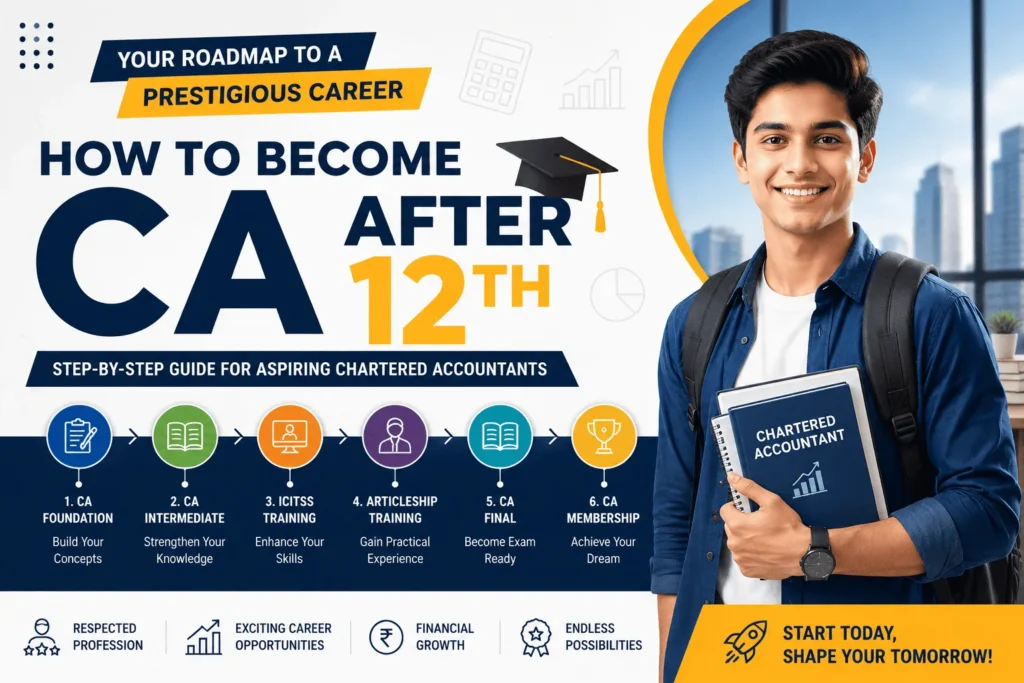
How to Become CA After 12th
Chartered Accountancy remains one of India’s most respected professions.
Many students explore this path immediately after school.
If you have completed Class 12, you can start your CA journey directly.
However, success requires planning, consistency, and patience.
This guide explains every stage clearly.
You will learn eligibility, registration, exams, training, costs, and career opportunities.
By the end, you will understand the complete roadmap toward becoming a Chartered Accountant.
Understanding the Chartered Accountancy Profession
A Chartered Accountant manages financial reporting, taxation, auditing, and compliance.
Companies rely on CAs for financial accuracy.
They also help businesses follow legal requirements.
Many CAs work in consulting, banking, taxation, and corporate finance.
Others build independent practices.
As economies become more regulated, demand for qualified professionals continues growing.
Therefore, CA remains a strong career option for commerce and non-commerce students.
Route to Chartered Accountancy After School
The Institute of Chartered Accountants of India (ICAI) regulates the CA profession.
Students can begin the process after passing Class 12.
The journey includes several stages.
These stages test technical knowledge and practical skills.
The pathway generally includes:
- CA Foundation Registration
- CA Foundation Examination
- CA Intermediate Registration and Exams
- Practical Training (Articleship)
- CA Final Examination
- Membership with ICAI
Each stage builds expertise progressively.
Eligibility Requirements for CA After Class 12
Students from any stream can apply.
Commerce students often find certain subjects familiar.
However, science and arts students can also succeed.
Basic eligibility includes:
- Passing Class 10 for provisional registration
- Passing Class 12 from a recognized board
- Meeting ICAI registration requirements
No specific percentage is mandatory for Foundation registration.
Still, stronger academic fundamentals can help.
Step 1: Register for CA Foundation
CA Foundation serves as the entry-level examination.
Students can register after Class 10.
However, they can appear only after passing Class 12.
Registration occurs through ICAI’s official portal.
Subjects Covered in CA Foundation
The syllabus includes four papers:
- Principles and Practice of Accounting
- Business Laws and Business Correspondence
- Business Mathematics, Logical Reasoning, and Statistics
- Business Economics and Commercial Knowledge
These subjects create a strong professional base.
Therefore, serious preparation becomes essential.
Preparation Tips for Foundation
Create a realistic study schedule.
Focus on concepts instead of memorization.
Practice mock tests regularly.
Also, solve previous examination papers.
Consistent revision improves retention significantly.
Step 2: Clear the CA Foundation Examination
After completing the required study period, students can appear.
ICAI conducts examinations periodically according to its schedule.
Students must achieve minimum passing criteria.
They need subject-wise qualifying marks.
They also need the required aggregate score.
Passing Foundation allows progression to the next level.
Therefore, many students treat this stage seriously.
Step 3: Register for CA Intermediate
After clearing Foundation, students can register for CA Intermediate.
This stage introduces advanced accounting and finance concepts.
The syllabus becomes more detailed.
Consequently, disciplined study becomes even more important.
Core Areas in CA Intermediate
The curriculum generally includes:
- Advanced Accounting
- Corporate and Other Laws
- Taxation
- Cost and Management Accounting
- Auditing Concepts
- Financial Management
Students learn practical applications alongside theory.
This balance prepares them for professional work.
Study Strategy for Intermediate
Break large topics into manageable sections.
Use ICAI study materials extensively.
Track weak areas every week.
Additionally, practice numerical problems repeatedly.
Regular self-assessment improves performance.
Alternative Path Versus Direct Entry
Many students compare different CA routes.
The Foundation route remains the standard path after Class 12.
Graduates may qualify through the Direct Entry Scheme.
However, school students generally follow Foundation first.
Therefore, understanding the Foundation pathway remains crucial.
Step 4: Complete the ICITSS Training
ICAI requires skill-based training programs.
Students complete the Integrated Course on Information Technology and Soft Skills.
This program develops workplace readiness.
Technical knowledge alone is insufficient.
Professional communication also matters.
Therefore, ICAI emphasizes practical skill development.
Step 5: Begin Articleship Training
Articleship represents one of the most important CA stages.
Students receive hands-on exposure in professional environments.
They work under practicing Chartered Accountants.
This training bridges theory and practice.
What Happens During Articleship?
Trainees participate in:
- Audit assignments
- Tax compliance work
- Financial statement preparation
- Client interactions
- Regulatory documentation
These experiences develop professional confidence.
Students learn industry realities firsthand.
Benefits of Practical Training
Articleship provides several advantages.
First, it develops technical competence.
Second, it improves communication skills.
Third, it builds professional networks.
Finally, it strengthens problem-solving abilities.
Many employers value this practical experience highly.
Step 6: Prepare for CA Final
CA Final represents the last examination stage.
The syllabus covers advanced professional subjects.
Students must demonstrate strong analytical skills.
The examination demands dedication and strategic preparation.
Key Areas in CA Final
Topics generally include:
- Financial Reporting
- Advanced Financial Management
- Auditing and Assurance
- Direct Tax Laws
- Indirect Tax Laws
- Strategic Management
These subjects reflect real-world professional responsibilities.
Therefore, conceptual clarity becomes essential.
Effective Preparation Methods
Develop a revision calendar early.
Focus on ICAI materials first.
Then use supplementary resources carefully.
Practice case-based questions regularly.
Furthermore, review amendments and updates frequently.
Step 7: Become an ICAI Member
After completing examinations and required training, students can apply for membership.
Once approved, they become Chartered Accountants.
This milestone opens numerous career opportunities.
Professionals can choose employment or practice.
Many also pursue specialized fields later.
Duration Needed to Become a CA
Students often ask about timelines.
The exact duration varies.
Exam performance affects overall completion time.
Generally, the journey requires several years.
Students who clear examinations promptly progress faster.
However, individual experiences differ.
Consistent effort often matters more than speed.
Cost of Pursuing Chartered Accountancy
CA remains comparatively affordable compared to many professional courses.
Costs typically include:
- Registration fees
- Examination fees
- Training expenses
- Study materials
- Coaching, if chosen
Actual expenses vary.
Students should verify current fees through ICAI.
Fee structures may change periodically.
Skills Needed for Success in CA
Academic knowledge alone does not guarantee success.
Certain professional skills help significantly.
Analytical Thinking
CAs interpret complex financial information.
Strong analysis improves decision-making.
Attention to Detail
Minor errors can create major consequences.
Accuracy remains essential.
Time Management
The syllabus is extensive.
Effective scheduling supports consistent progress.
Communication Skills
Professionals interact with clients and stakeholders.
Clear communication improves professional effectiveness.
Ethical Judgment
Trust forms the foundation of accountancy.
Ethical conduct protects professional credibility.
Career Opportunities After Qualifying
A CA qualification creates diverse opportunities.
Professionals can work across industries.
Corporate Sector Roles
Large companies hire CAs for:
- Financial reporting
- Internal audit
- Tax planning
- Risk management
- Budgeting
These positions often offer structured growth.
Public Practice
Many professionals establish independent firms.
They provide audit, taxation, and advisory services.
Entrepreneurial individuals often prefer this route.
Banking and Financial Services
Banks recruit qualified accountants frequently.
Roles include:
- Credit analysis
- Compliance
- Treasury functions
- Financial risk assessment
Consulting and Advisory
Consulting firms seek accounting expertise.
Professionals assist clients with strategic decisions.
Demand continues increasing across sectors.
Government and Regulatory Opportunities
Several public institutions value CA qualifications.
Professionals contribute to governance and financial oversight.
Common Challenges During the Journey
Every professional path presents obstacles.
CA preparation is no exception.
Managing a Vast Syllabus
The syllabus covers many subjects.
Therefore, planning becomes essential.
Handling Examination Pressure
Competitive examinations can feel demanding.
However, structured preparation reduces anxiety.
Balancing Training and Studies
Articleship requires commitment.
Students must manage responsibilities carefully.
Time-blocking often helps.
Staying Motivated
Results may not always match expectations.
Nevertheless, persistence remains important.
Many successful CAs faced setbacks before qualifying.
Mistakes Students Should Avoid
Certain mistakes can slow progress.
Avoid these common errors:
- Ignoring ICAI study materials
- Skipping revisions
- Relying only on memorization
- Neglecting mock examinations
- Poor time management
- Avoiding difficult topics
Addressing weaknesses early improves outcomes.
Why Chartered Accountancy Remains a Strong Career Choice
Businesses need financial transparency.
Governments require regulatory compliance.
Investors expect reliable reporting.
As a result, accounting professionals remain valuable.
Technology also creates new opportunities.
Modern CAs work with analytics, automation, and digital systems.
Therefore, the profession continues evolving.
Students who adapt to change can build rewarding careers.
Building a Strong Profile Beyond Exams
Professional growth extends beyond passing examinations.
Students should develop broader competencies.
Consider:
- Learning spreadsheet tools
- Understanding financial software
- Improving presentation skills
- Following taxation updates
- Reading business publications
These habits strengthen career readiness.
Employers increasingly value practical knowledge.
Final Thoughts
Choosing Chartered Accountancy after Class 12 can be a transformative decision.
The journey requires discipline and commitment.
However, the rewards can be significant.
Follow each stage carefully.
Focus on understanding concepts deeply.
Develop practical skills alongside academic knowledge.
Most importantly, remain consistent.
Steady effort often produces long-term success.
FAQs
Can I start CA immediately after Class 12?
Yes. Students can begin through the CA Foundation route after passing Class 12.
Is CA only for commerce students?
No. Students from science, arts, and commerce streams can pursue CA.
How difficult is the CA course?
The course is challenging. However, disciplined preparation improves success chances significantly.
Do I need coaching to clear CA exams?
No. Many students succeed through self-study. Coaching remains a personal choice.
Is articleship mandatory for becoming a CA?
Yes. Practical training forms an essential component of the qualification process.
Can I earn during articleship?
Yes. Articleship generally includes a stipend, subject to applicable ICAI guidelines.
What career options exist after becoming a CA?
Qualified professionals can work in auditing, taxation, consulting, banking, finance, and practice.
Does ICAI update the syllabus regularly?
Yes. ICAI periodically revises content to align with professional requirements.
References
- Institute of Chartered Accountants of India (ICAI) – Official Website
URL: https://www.icai.org - ICAI Student Services Portal
URL: https://eservices.icai.org - ICAI Board of Studies
URL: https://boslive.icai.org - Chartered Accountancy Course Information by ICAI
URL: https://www.icai.org/post/students - ICAI Examination Information
URL: https://icaiexam.icai.org
Disclaimer: Course structures, examination patterns, training requirements, and fees may change. Always verify the latest information through official ICAI sources.
, Author Mr. Sanjeev is a taxation trainer and accounting educator with experience in GST, income tax, and financial compliance training. Connect IPA at