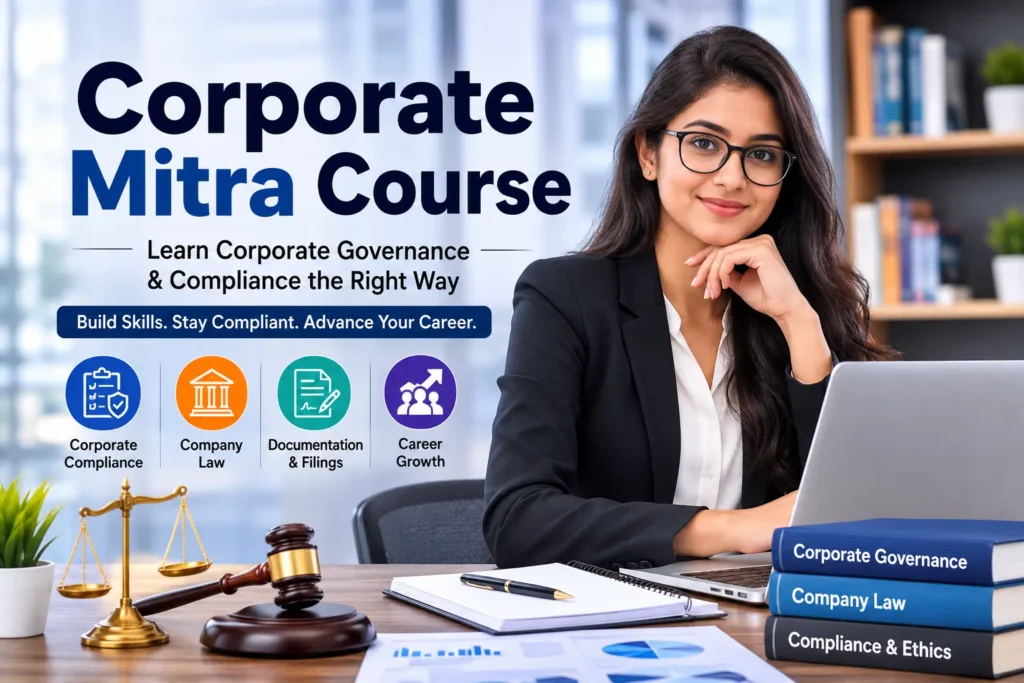
Corporate Mitra Course
Businesses operate in a highly regulated environment today. Every organization needs professionals who understand governance, compliance, and legal responsibilities. That demand has increased the popularity of the Corporate Mitra Course among students and working professionals.
The program introduces practical corporate compliance concepts through structured learning. It also helps learners understand company law, regulatory filings, and governance practices.
Moreover, the course bridges the gap between academic knowledge and workplace expectations. As a result, learners become more confident while handling compliance-related responsibilities.
Why Corporate Governance Training Matters
Every company must comply with legal and regulatory obligations. Failure to meet those standards can lead to financial penalties and reputational damage.
Therefore, organizations seek trained professionals who understand statutory compliance. Proper training also improves transparency, accountability, and ethical decision-making.
Additionally, businesses value employees who reduce compliance risks before problems arise. That makes governance education increasingly relevant.
What Is the Corporate Mitra Course?
The Corporate Mitra Course is a professional learning program designed to build corporate compliance knowledge. It covers practical concepts required in modern business environments.
The curriculum typically focuses on company law, board procedures, statutory filings, corporate documentation, and governance practices.
Unlike traditional classroom learning, many providers include real-world case studies. Consequently, learners understand how compliance works in everyday business operations.
Key Topics Covered During the Program
Although course modules vary by provider, most programs include several essential subjects.
Company Law Fundamentals
Participants learn the legal framework governing businesses. They also understand company formation, management structures, and legal responsibilities.
Corporate Compliance
This section explains statutory obligations that organizations must follow. Learners become familiar with routine compliance procedures and reporting requirements.
Board Meetings and Documentation
Proper documentation supports effective corporate governance.
Students learn how to prepare agendas, meeting minutes, board resolutions, and compliance registers accurately.
Regulatory Filings
Businesses must submit various filings within prescribed timelines.
The course introduces filing procedures, documentation standards, and regulatory requirements under applicable laws.
Corporate Ethics
Ethical practices strengthen business credibility.
Therefore, learners explore professional ethics, governance principles, and responsible decision-making.
Skills Developed Through Corporate Compliance Learning
Completing this program develops practical workplace abilities.
These skills often include:
- Corporate documentation
- Compliance management
- Legal interpretation
- Regulatory awareness
- Business communication
- Analytical thinking
- Professional ethics
- Risk identification
- Documentation accuracy
- Time management
Consequently, graduates become more prepared for compliance-focused responsibilities.
Who Should Consider This Program?
The learning program benefits several categories of professionals.
Commerce Students
Students gain practical exposure beyond textbooks.
That experience strengthens employability after graduation.
Company Secretarial Aspirants
The course complements professional studies by offering practical compliance knowledge.
Legal Professionals
Law graduates improve their understanding of corporate governance procedures.
Finance Professionals
Accountants and finance executives frequently work alongside compliance teams.
Therefore, governance knowledge improves cross-functional collaboration.
Entrepreneurs
Business owners also benefit from understanding regulatory obligations.
Better compliance reduces operational risks and strengthens business credibility.
Benefits of Corporate Mitra Training
Professional learning delivers long-term career value.
Some notable advantages include:
Practical Industry Knowledge
Real-life examples improve concept clarity.
Learners understand workplace expectations instead of theoretical concepts alone.
Improved Career Opportunities
Many organizations recruit professionals with compliance awareness.
Relevant skills often increase interview confidence and workplace readiness.
Better Understanding of Corporate Regulations
Regulatory requirements continue evolving.
Continuous learning helps professionals remain informed about governance expectations.
Enhanced Professional Credibility
Employers appreciate candidates who understand compliance responsibilities.
That knowledge demonstrates commitment to professional development.
Choosing the Right Corporate Education Program
Not every training provider offers the same quality.
Before enrolling, evaluate several important factors.
Check Faculty Experience
Experienced trainers usually explain practical challenges more effectively.
Industry exposure adds valuable learning perspectives.
Review the Curriculum
A comprehensive syllabus should include governance, documentation, compliance, and case studies.
Practical assignments improve learning outcomes.
Verify Learning Support
Quality programs provide doubt-solving sessions, recorded lectures, and updated study materials.
These resources improve the overall learning experience.
Look for Practical Exposure
Assignments based on actual corporate situations strengthen professional skills significantly.
Hands-on practice also builds confidence.
Career Opportunities After Completion
Corporate governance knowledge opens multiple career pathways.
Possible opportunities include:
- Compliance Executive
- Corporate Governance Associate
- Legal Compliance Officer
- Secretarial Assistant
- Corporate Documentation Executive
- Regulatory Affairs Associate
- Risk and Compliance Analyst
- Governance Support Executive
Career growth depends on qualifications, experience, and continuous learning.
Common Misconceptions About Corporate Governance Courses
Many people misunderstand compliance education.
Let’s clarify several myths.
Myth: Only Company Secretaries Need It
This belief is inaccurate.
Compliance responsibilities involve finance, legal, human resources, and management teams.
Myth: Governance Is Purely Legal Work
Corporate governance extends beyond legal documentation.
It also supports transparency, accountability, ethics, and business sustainability.
Myth: The Learning Ends After Certification
Corporate regulations change regularly.
Professionals should continue learning throughout their careers.
How This Training Supports Long-Term Professional Growth
Modern businesses increasingly prioritize regulatory compliance.
Consequently, governance professionals remain valuable across industries.
Continuous skill development improves adaptability.
It also creates opportunities for promotions and specialized roles.
Moreover, governance knowledge supports responsible leadership.
Organizations benefit from professionals who understand compliance before issues develop.
Frequently Asked Questions
What is the Corporate Mitra Course?
The Corporate Mitra Course teaches practical corporate governance, company law, documentation, and compliance skills for professional development.
Who can join this course?
Commerce students, graduates, legal professionals, finance executives, entrepreneurs, and compliance aspirants can benefit from this learning program.
Does the course improve employability?
Yes. Practical compliance knowledge strengthens job readiness and supports careers in governance-related roles.
Is previous corporate experience necessary?
No. Many programs begin with foundational concepts before progressing to advanced compliance topics.
How should I choose a training provider?
Review faculty expertise, curriculum quality, practical assignments, learner support, and industry relevance before enrolling.
Final Thoughts
Corporate governance continues shaping modern business operations. Organizations increasingly value professionals who understand compliance responsibilities.
The Corporate Mitra Course offers practical knowledge that supports career growth and professional credibility. However, learners should compare providers carefully before enrolling. A well-designed program combines expert instruction, practical assignments, and updated regulatory knowledge. Those elements create stronger workplace readiness and long-term career value.
References
- Institute of Company Secretaries of India (ICSI) – https://www.icsi.edu/
- Ministry of Corporate Affairs, Government of India – https://www.mca.gov.in/
- Organisation for Economic Co-operation and Development (OECD) Corporate Governance – https://www.oecd.org/corporate/