What Are Golden Rules of Accounting? | लेखांकन के स्वर्णिम नियम क्या हैं
Accounting builds financial clarity for every organization and individual decision.
लेखा प्रणाली व्यवसाय के प्रत्येक लेनदेन को व्यवस्थित रूप से दर्ज करती है।
Golden rules of accounting form the backbone of journal entries.
ये नियम सटीकता, पारदर्शिता और विश्वसनीयता सुनिश्चित करते हैं।
Understanding these rules improves decision-making and compliance with financial laws.
इन सिद्धांतों का ज्ञान व्यावसायिक सफलता के लिए आवश्यक माना जाता है।
Golden rules guide the recording of debit and credit entries.
ये नियम प्रत्येक वित्तीय लेनदेन को सही दिशा प्रदान करते हैं।
They ensure every transaction maintains dual aspect accounting.
हर लेनदेन में दो पक्ष होते हैं, जो संतुलन बनाए रखते हैं।
Therefore, these principles help maintain accurate financial statements.
इसी कारण यह प्रणाली वित्तीय रिपोर्टिंग को मजबूत बनाती है।
Core Accounting Principles | मूल लेखा सिद्धांत
Accounting works on structured rules and standardized concepts globally.
लेखांकन प्रणाली विश्वभर में समान सिद्धांतों पर आधारित रहती है।
These rules simplify complex financial transactions into understandable records.
यह नियम जटिल लेनदेन को सरल रूप में प्रस्तुत करते हैं।
Hence, students and professionals must understand these rules deeply.
इसलिए प्रत्येक विद्यार्थी और पेशेवर को इनका गहरा ज्ञान होना चाहिए।
Three Golden Rules Explained | तीन प्रमुख स्वर्णिम नियम
Personal Account Rule | व्यक्तिगत खाता नियम
Personal accounts include individuals, firms, and companies.
व्यक्तिगत खाते में व्यक्ति, संस्था और कंपनी शामिल होते हैं।
This rule focuses on transactions involving persons or entities.
यह नियम व्यक्तियों से जुड़े लेनदेन पर केंद्रित होता है।
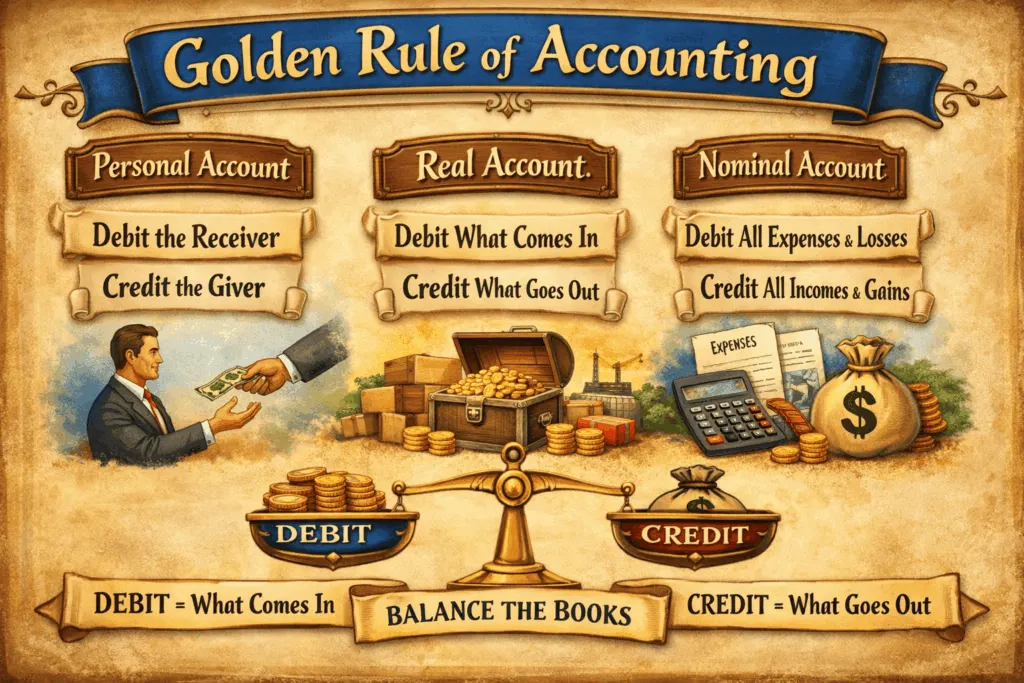
Rule: Debit the receiver, credit the giver.
प्राप्त करने वाले को डेबिट करें और देने वाले को क्रेडिट करें।
Whenever a person receives value, debit that account.
जब कोई मूल्य प्राप्त करता है, तब उसका खाता डेबिट होता है।
Similarly, credit the person who provides value.
उसी प्रकार देने वाले को क्रेडिट किया जाता है।
Real Account Rule | वास्तविक खाता नियम
Real accounts represent assets owned by the business.
वास्तविक खाते व्यवसाय की संपत्तियों को दर्शाते हैं।
These include tangible and intangible resources.
इनमें मूर्त और अमूर्त दोनों प्रकार की संपत्तियां शामिल होती हैं।
Rule: Debit what comes in, credit what goes out.
जो अंदर आए उसे डेबिट करें और जो बाहर जाए उसे क्रेडिट करें।
Assets entering business increase value and require debit entry.
व्यवसाय में आने वाली संपत्ति को डेबिट किया जाता है।
Assets leaving business reduce value and require credit entry.
बाहर जाने वाली संपत्ति को क्रेडिट किया जाता है।
Nominal Account Rule | नाममात्र खाता नियम
Nominal accounts deal with expenses, losses, incomes, and gains.
नाममात्र खाते खर्च, हानि, आय और लाभ से जुड़े होते हैं।
They help calculate profit or loss during a financial period.
ये खातें लाभ या हानि की गणना में सहायता करते हैं।
Rule: Debit all expenses and losses, credit all incomes and gains.
सभी खर्च और हानि को डेबिट करें तथा आय और लाभ को क्रेडिट करें।
Expenses increase debit side entries in accounting.
खर्च डेबिट पक्ष को बढ़ाते हैं।
Income increases credit side entries.
आय क्रेडिट पक्ष को बढ़ाती है।
Importance of Accounting Rules | लेखांकन नियमों का महत्व
Accounting rules ensure consistency in financial reporting.
लेखांकन नियम वित्तीय रिपोर्टिंग में एकरूपता बनाए रखते हैं।
They reduce errors and prevent fraud in financial systems.
यह त्रुटियों को कम करते हैं और धोखाधड़ी को रोकते हैं।
Moreover, businesses rely on accurate records for strategic decisions.
इसके अलावा व्यवसाय सही निर्णय लेने के लिए इन पर निर्भर रहते हैं।
Types of Accounts in Accounting | लेखांकन में खातों के प्रकार
Personal Accounts Overview | व्यक्तिगत खाते का विवरण
Personal accounts track transactions with individuals or organizations.
व्यक्तिगत खाते व्यक्तियों और संस्थाओं के साथ लेनदेन दर्शाते हैं।
Examples include customers, vendors, and employees.
उदाहरण के रूप में ग्राहक, विक्रेता और कर्मचारी शामिल हैं।
Real Accounts Overview | वास्तविक खाते का विवरण
Real accounts represent assets and resources of the business.
वास्तविक खाते व्यवसाय की संपत्तियों को दर्शाते हैं।
Examples include cash, machinery, and furniture.
उदाहरण में नकद, मशीन और फर्नीचर शामिल हैं।
Nominal Accounts Overview | नाममात्र खाते का विवरण
Nominal accounts represent expenses and incomes.
नाममात्र खाते खर्च और आय को दर्शाते हैं।
They help determine overall business profitability.
यह व्यवसाय की कुल लाभप्रदता निर्धारित करते हैं।
Practical Examples of Golden Rules | व्यावहारिक उदाहरण
Example: Cash Received from Customer | ग्राहक से नकद प्राप्ति
Cash comes into business, so debit cash account.
नकद व्यवसाय में आता है, इसलिए नकद खाता डेबिट होता है।
Customer gives money, so credit customer account.
ग्राहक पैसा देता है, इसलिए उसका खाता क्रेडिट होता है।
Example: Purchase of Furniture | फर्नीचर की खरीद
Furniture enters business, so debit furniture account.
फर्नीचर व्यवसाय में आता है, इसलिए फर्नीचर खाता डेबिट होता है।
Cash goes out, so credit cash account.
नकद बाहर जाता है, इसलिए नकद खाता क्रेडिट होता है।
Example: Salary Paid | वेतन भुगतान
Salary is an expense, so debit salary account.
वेतन खर्च है, इसलिए वेतन खाता डेबिट होता है।
Cash decreases, so credit cash account.
नकद कम होता है, इसलिए नकद खाता क्रेडिट होता है।
Journal Entries and Application | जर्नल प्रविष्टियां और उपयोग
Journal entries record financial transactions in chronological order.
जर्नल प्रविष्टियां लेनदेन को क्रमवार दर्ज करती हैं।
Each entry follows debit and credit structure strictly.
हर प्रविष्टि डेबिट और क्रेडिट नियमों का पालन करती है।
Thus, golden rules simplify journal entry creation effectively.
इस प्रकार यह नियम जर्नल प्रविष्टियों को सरल बनाते हैं।
Difference Between Traditional and Modern Accounting | पारंपरिक और आधुनिक लेखांकन अंतर
Traditional accounting focuses on manual record keeping systems.
पारंपरिक लेखांकन मैनुअल रिकॉर्डिंग पर आधारित होता है।
Modern accounting uses software and automation tools.
आधुनिक लेखांकन सॉफ्टवेयर और तकनीक का उपयोग करता है।
However, golden rules remain constant across both systems.
फिर भी स्वर्णिम नियम दोनों में समान रहते हैं।
Common Mistakes in Applying Rules | सामान्य त्रुटियां
Students often confuse account classification types.
विद्यार्थी अक्सर खातों के वर्गीकरण में भ्रमित होते हैं।
Incorrect debit and credit entries create imbalance.
गलत प्रविष्टियां असंतुलन उत्पन्न करती हैं।
Therefore, practice improves accuracy and confidence.
इसलिए अभ्यास से सटीकता बढ़ती है।
Benefits of Learning Accounting Rules | लाभ
These rules improve financial accuracy and reporting quality.
ये नियम वित्तीय सटीकता को बढ़ाते हैं।
They also support audit and compliance processes.
यह ऑडिट और अनुपालन में सहायक होते हैं।
Hence, professionals gain credibility and trust in industry.
इससे पेशेवरों की विश्वसनीयता बढ़ती है।
Real-Life Applications | वास्तविक जीवन में उपयोग
Businesses use these rules for daily financial transactions.
व्यवसाय दैनिक लेनदेन के लिए इन नियमों का उपयोग करते हैं।
They help in preparing balance sheets and income statements.
यह बैलेंस शीट और आय विवरण तैयार करने में सहायक हैं।
Future Scope in Accounting Field | भविष्य की संभावनाएं
Accounting remains a stable and growing career field globally.
लेखांकन क्षेत्र भविष्य में भी स्थिर और विकासशील रहेगा।
Digital transformation increases demand for skilled accountants.
डिजिटल परिवर्तन कुशल पेशेवरों की मांग बढ़ाता है।
Trusted Sources and References
For further reading and validation, refer to these sources:
These platforms provide reliable and updated accounting knowledge.
FAQs on Golden Rules of Accounting
What are golden rules of accounting?
Golden rules define how debit and credit entries are recorded systematically.
Why are these rules important?
They ensure accuracy, consistency, and reliability in financial records.
What are the three main rules?
Personal, real, and nominal account rules form the core principles.
What is a personal account?
It represents individuals, firms, and organizations in accounting.
What is a real account?
It represents assets owned by the business.
What is a nominal account?
It represents expenses, losses, incomes, and gains.
How do debit and credit work?
Debit records incoming value, while credit records outgoing value.
Can accounting rules change over time?
Core rules remain constant, though technology changes application methods.
Are golden rules used in modern accounting?
Yes, they are still used in software-based accounting systems.
How can I learn these rules effectively?
Practice journal entries regularly and understand concepts clearly.
Author Sanjeev Malik is a taxation trainer and accounting educator with experience in GST, income tax, and financial compliance training. Connect IPA at